Contractor Reputation Management
Most contractors win jobs on quality. They lose them on reputation. A homeowner searching for a roofer or plumber is looking at your Google reviews before they ever look at your website. If your review count is low, your rating is mediocre, or you're not responding they're calling someone else. This guide covers how to build a review system that gets you more 5-star ratings and helps you rank higher in local search at the same time.
Why Google Reviews Directly Affect Your Local Rankings
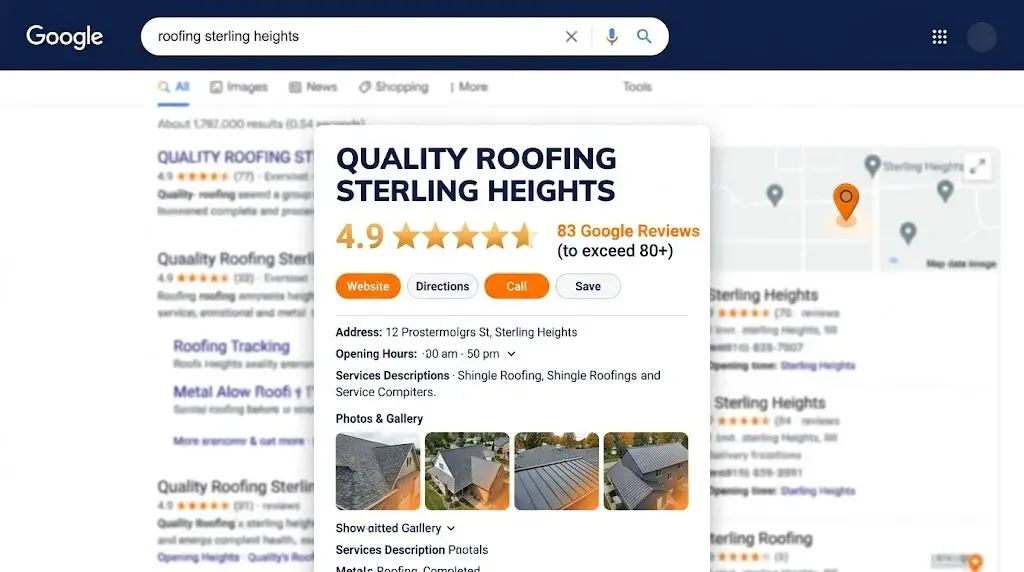
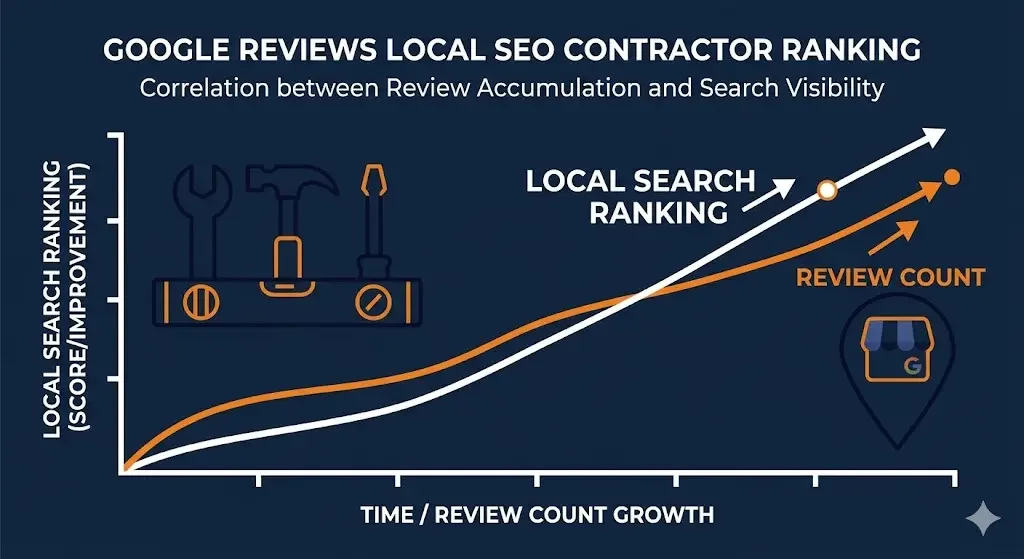
Google uses reviews as a local ranking signal. More reviews, higher ratings, and consistent review activity all tell Google that your business is active, trusted, and worth showing to homeowners nearby. This is not a soft benefit. It is a direct input into where you show up in the local pack and on Google Maps.
What Google is measuring:
Total number of reviews on your GBP
Average star rating
How recently reviews were left, because fresh activity outperforms old bulk reviews
Whether you are responding to reviews, since engagement signals legitimacy
Keywords homeowners use inside reviews, such as "roofing," "HVAC," "fast," and "professional"
Pro tip:A contractor with 40 reviews at 4.8 stars who gets 3 new reviews per month will consistently outrank a competitor with 100 reviews at 4.6 stars who stopped getting reviews a year ago. Recency matters.
How to Get More Google Reviews as a Contractor
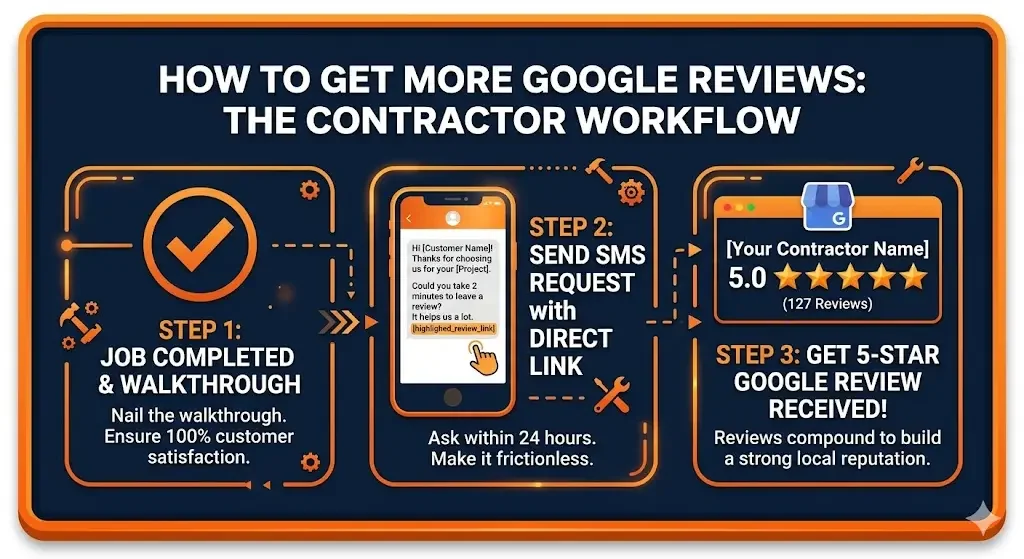
The number one reason contractors do not have enough reviews is simple. They never ask. Most satisfied customers will not leave a review on their own. The job is done, they are happy, and they move on. Your job is to make asking for a review a standard part of every completed project.
The review request process that works:
Ask in person first. Do it right after the job is done, while the homeowner is still happy and standing in front of you. Say: "If you are happy with the work, would you mind leaving us a quick Google review? It takes about a minute."
Follow up by text the same day. Send a direct link to your Google review page. No friction, no searching required.
Create a QR code. Print it on an invoice, a door hanger, or a business card so homeowners can scan it on the spot.
Send one follow-up. If they did not leave a review within 3 days, send one more message. One follow-up only.
What kills your review rate:
Asking days or weeks after the job, when the moment of satisfaction has passed
Sending a generic email with no direct link, which creates too much friction
Never asking at all and hoping reviews come in on their own
For a complete look at how your Google Business Profile affects local rankings, read: Google Business Profile Audit for Contractors
How to Respond to Google Reviews the Right Way
Responding to every review, good and bad, is one of the most overlooked parts of contractor reputation management. Google sees responses as engagement. Homeowners see them as professionalism. Both matter for your rankings and your conversion rate.
For 5-star reviews:
Thank them by name if possible
Reference the specific job, such as "glad the roof repair held up before the rain"
Keep it short, because 2 to 3 sentences is enough
Never use a copy-paste template for every response, since Google and homeowners both notice
For negative reviews:
Respond within 24 hours, because the longer you wait, the worse it looks
Stay professional and do not argue or get defensive
Acknowledge the issue and offer to make it right offline
Keep the response short: "We are sorry to hear this was not the experience we aim to deliver. Please reach out to us directly so we can resolve this."
Never post personal information about the customer
Pro tip: A contractor who responds to a 1-star review professionally often earns more trust from future homeowners than one who only has perfect reviews. It shows you take accountability seriously.
How Reviews Connect to Your Local SEO Rankings
Reviews do not just build trust. They feed your local SEO directly. Homeowners who write reviews often use the same words they would type into a search: "best roofer in Detroit," "fast HVAC repair," "honest plumber." Those words inside your reviews act as additional keyword signals for Google.
How to make reviews work harder for local SEO:
Keep your GBP completely filled out, because reviews on an incomplete profile carry less weight
Respond to every review to signal ongoing engagement
Do not incentivize reviews, since Google prohibits offering discounts or gifts in exchange and will remove them
Focus on volume and consistency, because 5 reviews per month beats 50 reviews in one month followed by nothing
Get a Free Reputation and Local SEO Consultation
Not sure where your reputation stands or how your reviews are affecting your local rankings? Dawla Marketing helps contractors build review systems and local SEO strategies that generate consistent inbound leads.
FAQs
-
There is no fixed number. What matters more is having more reviews than your local competitors, a rating above 4.5 stars, and consistent new review activity. A contractor with 30 recent reviews at 4.8 stars will often outrank one with 200 old reviews and no recent activity.
-
Yes. Asking customers directly for reviews is allowed and encouraged by Google. What is not allowed is offering incentives — discounts, gifts, or anything of value in exchange for a review. Google will remove incentivized reviews and can penalize your listing for the practice.
-
Yes. Google has confirmed that responding to reviews signals active engagement with your business profile. Consistent responses — on both positive and negative reviews — are a best practice for local SEO and demonstrate to potential customers that you are responsive and professional.