Local Keyword Research for Contractors
Getting found on Google starts with knowing what your customers are actually typing. Local keyword research is the process of finding those exact terms that searches are happening in your city, your trade, and your service area, so your website shows up when homeowners need what you offer. This guide covers how to find local keywords, how to prioritize them, and which tools to use, with real examples built for roofing, HVAC, plumbing, and electrical contractors.

What Is Local Keyword Research?
Local keyword research is the process of finding search terms that include a geographic modifier, or that trigger local search results phrases like "roofing contractor Detroit" or "HVAC repair near me." For contractors, these are the keywords that bring traffic from homeowners in your service area who are actively looking to hire. The goal is not high volume. It is the right volume from the right location.
Most contractor websites chase broad terms like "roofing contractor" or "HVAC company." Those terms are dominated by national directories and franchise brands with years of authority behind them. Local keyword research shifts your focus to the terms where you can realistically compete and win real leads.
Why Local Keyword Research Is Different for Contractors
Contractors do not need national traffic. They need calls from homeowners in their city, their county, and the neighborhoods they actually serve. A plumber in Phoenix needs different keywords than a plumber in Boston, even if they do the same work. That geographic reality changes how you approach keyword research from the ground up.
Three things separate local keyword research from general SEO keyword research:
Geography matters more than volume. A keyword with 200 monthly searches in your city is worth more to your business than one with 10,000 national monthly searches you will never convert.
Service-plus-city combinations are your core targets. "Roof replacement Tampa" beats "roof replacement" every time for a Tampa roofer.
Search intent is already high. Someone searching "emergency plumber near me" at 11 pm is not browsing. They need help right now, and they are calling whoever shows up first.
How to Do Local Keyword Research for Contractors
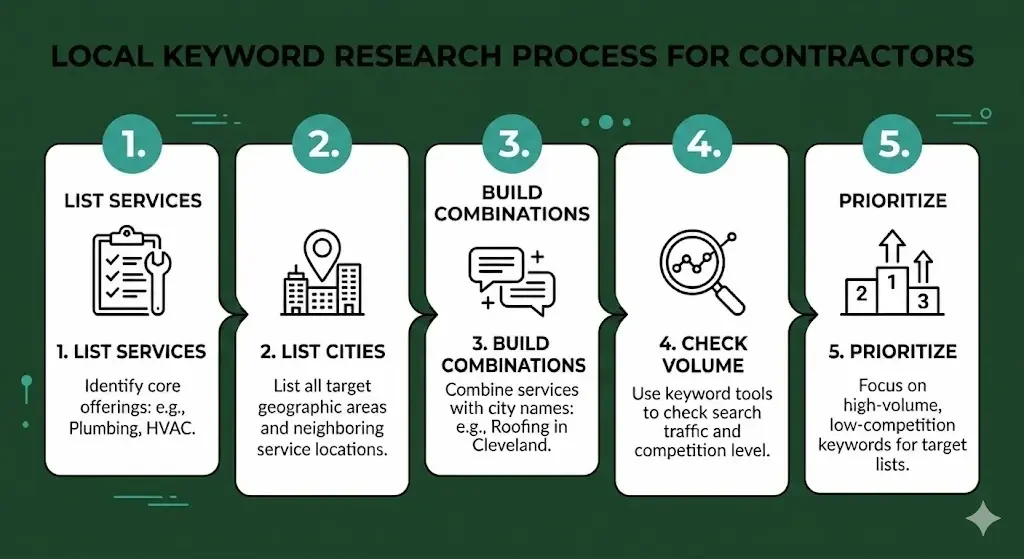
Start with your core services, pair them with the cities you work in, and run the combinations through keyword tools to check volume and competition. That process covers the foundation of local SEO keyword research for any trade, and it works whether you're a roofer, an HVAC contractor, or an electrician.
Work through it in this order:
List every service you offer. Be specific. Not just "roofing", roof replacement, roof repair, emergency tarping, gutter installation, flat roof repair, storm damage repair. Every service is a keyword opportunity.
List every city and neighborhood you work in. Your primary city, surrounding cities, key suburbs, and, in large metros, specific neighborhoods that carry their own search volume.
Build service-plus-city combinations. "Roof replacement [city]," "emergency roofer [city]," "licensed plumber [city]" these combinations become your core service pages.
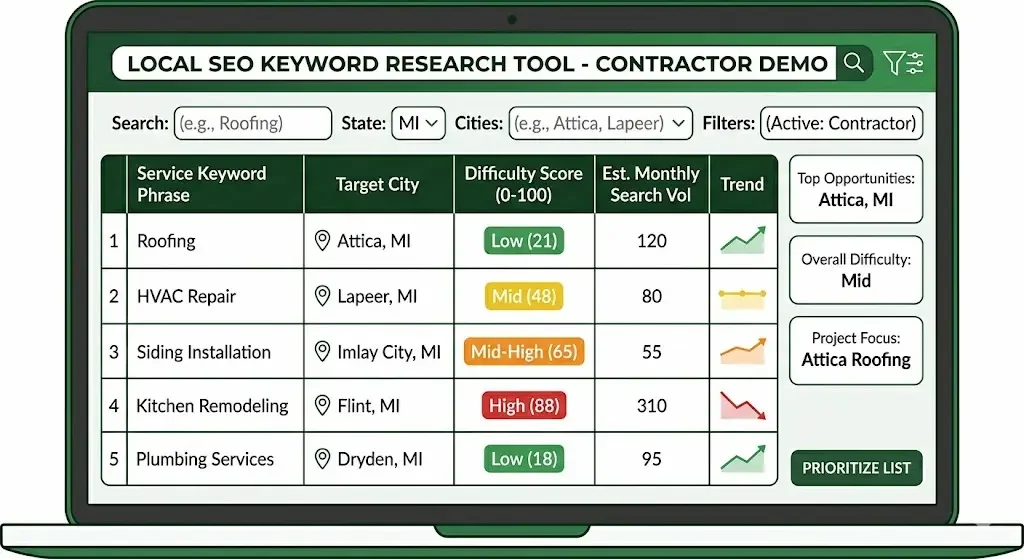
Run them through a keyword tool. Use Ahrefs, Google Keyword Planner, or both to check search volume and keyword difficulty for each combination.
Mine the related terms and questions. Tools surface keyword variations and question-based searches you would not find on your own. "How much does a roof replacement cost in [city]?" is a keyword. So is "best roofing company [city] reviews."
For a full breakdown of how those service-plus-city combinations translate into pages your site needs, see Local SEO Landing Pages for Contractors.
Roofing SEO Keywords: What to Target
Roofing keyword research follows a clear pattern. High-intent terms combine a specific service type with a location or urgency signal. Your fastest wins come from repair terms, cost questions, and emergency service searches, not from trying to rank for "roofing contractor" against national directories with thousands of backlinks.
Strong local roofing keyword targets:
roof replacement [city]
roofing contractor [city]
roof repair near me
emergency roof repair [city]
How much does a roof replacement cost in [city]
best roofing company [city]
metal roofing [city]
flat roof repair [city]
storm damage roof repair [city]
roof inspection [city]
Pro Tip: "Roof repair near me" often pulls more searches than "roof repair [city name]" in many local markets. Build content targeting both. Google connects the "near me" query to your business using your Google Business Profile location and the searcher's device GPS, not because you wrote "near me" anywhere on your page.
HVAC Keywords for SEO: What to Target
HVAC keyword research splits across two intent types: emergency searches from homeowners with a broken system, and planned searches from people comparing options before summer or winter. Both are worth targeting. Emergency searches convert faster because the homeowner needs someone today. Planned searches give you more time to build trust before the call comes in.
Strong local HVAC keyword targets:
HVAC repair [city]
AC repair near me
furnace repair [city]
HVAC installation [city]
air conditioning replacement [city]
How much does AC replacement cost in [city]
HVAC contractor near me
heating and cooling company [city]
emergency HVAC repair [city]
central air installation [city]
How to Prioritize Keywords Once You Have a List
Not every keyword on your list needs a page right now. Sort by three factors: search intent, keyword difficulty, and how close the searcher is to actually hiring someone. Start where intent is highest, and competition is lowest. That combination produces the fastest returns, and the fastest results build momentum for harder keywords later.
Use this framework to decide what to build first:
Start with high-intent, low-difficulty terms. Repair and emergency service keywords typically carry less competition than broad "contractor" terms. Build those pages before anything else.
One page per keyword cluster. A roofer in Tampa needs a page for "roof replacement Tampa," a separate page for "roof repair Tampa," and a separate page for "emergency roofing Tampa." Each page targets one cluster, not everything at once.
Use question keywords for blog content. "How much does a new roof cost in [city]" is a blog post. It captures homeowners in the research phase and builds trust before they contact anyone.
Save high-difficulty terms for later. Once you have local rankings and some domain authority built up, go after harder terms. Competing nationally before you rank locally is a waste of budget and time.
Local SEO Keyword Research Tools Worth Using
You do not need every tool on the market. You need ones that show local search volume, keyword difficulty, and the actual questions homeowners are typing. A free tool plus one paid tool covers most contractors well, and for the first year, that is enough to build serious traction.
Tools worth having in your workflow:
Google Keyword Planner.Free with a Google account. Confirms search volume and surfaces related terms. Run keywords in batches of 10 for the most accurate volume data.
Ahrefs Keywords Explorer. The most reliable data for keyword difficulty and traffic potential. If you are serious about ranking, this is worth the subscription.
Google Search Autocomplete. Type any service plus your city into Google and look at the auto-populated suggestions. Those are real searches people are running right now no tool required.
Google People Also Ask.The PAA box on any search result shows the questions homeowners are actively asking about your keyword. Every question is a potential blog topic or FAQ section.
BrightLocal. Built for local SEO. Tracks how your keywords rank across different zip codes in your service area, which matters when you cover multiple cities.
Get Contractor Keywords That Actually Bring Leads
Knowing which keywords to target is only the first step. At Dawla Marketing, we build contractor SEO strategies around the exact terms your local customers are searching so your pages rank for the searches that turn into phone calls, not just traffic that goes nowhere.
[Book Your Free Strategy Call → https://www.dawlamarketing.com/contact]
FAQs
-
Contractors should build their core service pages around service pluscity combinations "roof replacement [city]," "HVAC repair near me," "licensed electrician [city]." These are the terms homeowners actually search when they are ready to hire. Blog content should target question-based keywords like "how much does a new roof cost in [city]" or "signs you need AC repair" to capture homeowners earlier in their research. Avoid chasing broad terms like "roofing contractor" without city modifiers those are dominated by national directories and will not bring you local leads.
-
No. Writing "near me" directly on your website does not help you rank for "near me" searches. Google connects those searches to local businesses using your Google Business Profile location data and the searcher's GPS not because the phrase appears on your page. What actually helps is having a fully optimized Google Business Profile, accurate service area settings, consistent NAP across directories, and strong local reviews.
-
For Google Maps results, most contractors see meaningful movement within one to two months of optimizing their Google Business Profile and building consistent citations. Organic rankings on the main Google results page typically take two to four months for low-competition local terms, and four to six months or longer for competitive city markets. Larger cities like Chicago, Houston, or Los Angeles take longer than smaller markets because there are more established competitors.